
Asking a Multiple Part 3 of 3: Questions We Will Not Engage With
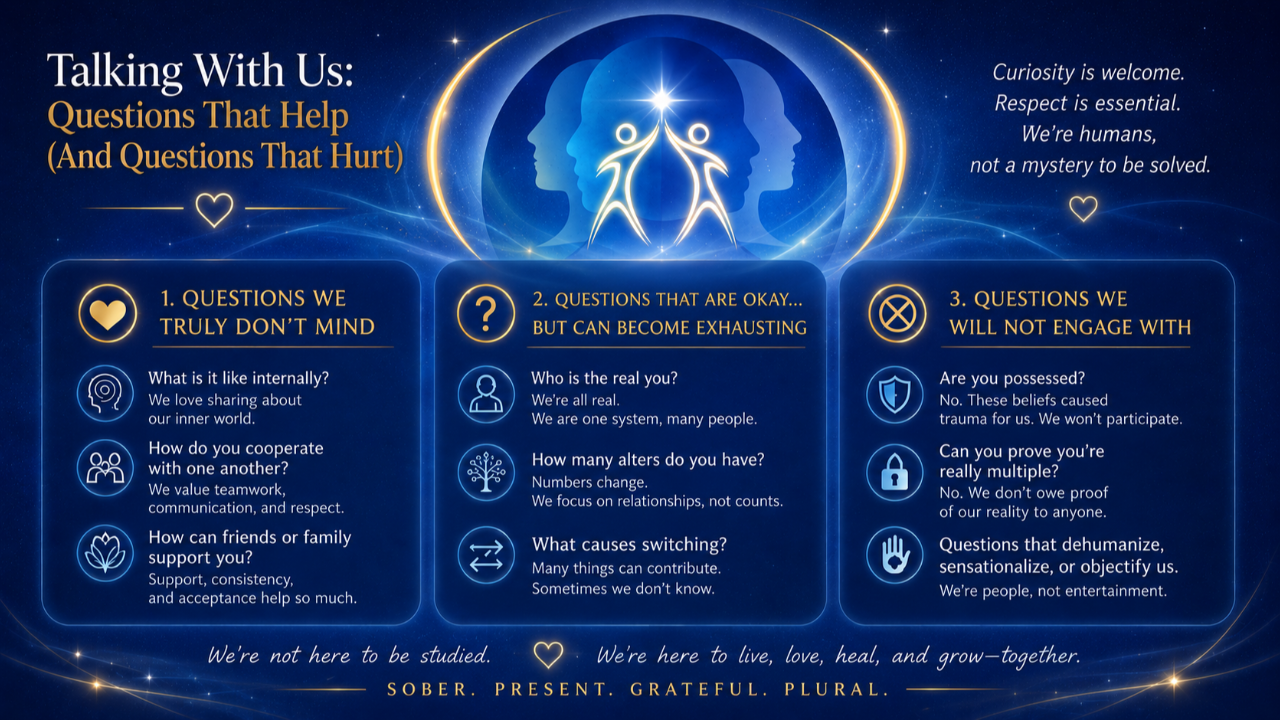
Our thoughts on curiosity and boundaries in a world that wasn’t designed by or for dissociative systems: Part 3 of 3
This is the third post in our three-part series where we answer common questions we hear. Our previous posts addressed questions we genuinely don't mind people asking, as well as questions that are okay but which we find tiring.
Today's Category: Questions We Will Not Engage With
This category includes questions that cross boundaries for us and might be harmful because they tend to dehumanize, sensationalize, invalidate our lived experience, or echo previous trauma.
Plus, some of them are just rude. And if you’re not sure whether it’s rude, imagine how you’d feel if somebody asked the same thing of you.
We’ll answer these questions here as a reference point. But if you ask them of us directly we will not engage.
“Are you possessed by [demons/evil spirits/negative entities]?”
No.
We need people to understand that this question is not abstract for us and is not a harmless thing to ask.
Two of our headmates were born of a traumatic attempted exorcism carried out by authority figures who interpreted our multiplicity through a rigid religious lens. That experience caused real psychological harm, even if it did produce two beautiful members of our family who we now love and cherish.
Over just the last year, we have experienced well-meaning people trying to “clear” some of us out of the body ... others have asked why they keep “attracting these entities.”
Please don’t do those things without our consent and please don’t ask those questions.
Keep in mind that the people saying and doing these sorts things are acting upon layered misconceptions: namely, that there is one core "real Ian" who has an exclusive claim to our body and that whichever alter they happen to be speaking to in the moment is the "real Ian." As discussed in our previous post, that simply isn't how DID works and it certainly is not how we experience ourselves.
So when people ask whether our headmates are demons, spirits, or entities that need to be “cleared,” it does not feel intellectually curious. It feels like assumptions and inapplicable frameworks are being imposed on us. It feels like we're being told we are broken and in need of fixing. At our core, it feels threatening, invalidating, and deeply hurtful.
You are allowed to have your spiritual beliefs. You are allowed to live in a paradigm that does not have room for genuine plural existence within a single body.
And we are allowed to set this boundary. We will not engage in conversations that frame our existence as wrong or corrupted or evil. Nor will we engage with questions that imply we are sort of contamination or infestation.
“Are you dangerous?”
On occasion, someone has the nerve to ask this directly. More often it’s implied in other things they are asking.
The answer is no.
We are not more dangerous than the average human being, and statistically we are probably much less dangerous. Systems are far more likely to have been harmed than to harm others, and tend to be highly empathetic.
We understand this question comes from popular media, which has done immense damage. Movies love the trope of the violent, unpredictable person with multiple personalities because it’s sensational and profitable. It’s also wildly unrepresentative of how most actual systems function in real life.
We are accountable for our behavior like any other human being. Having DID does not exempt us from ethics or responsibility. And we take collective accountability for our actions regardless of who is fronting.
But we reject the assumption that plurality itself equals danger.
“Can you please not switch in front of me?”
We find this question especially hurtful. It’s basically asking some of us not to exist in your presence. None of us needs permission to exist in a body that belongs equally to all of us.
We may not announce the switch (indeed most of the time we don’t). And we may choose not to switch because some of us don’t feel safe with you. But we won’t suppress an otherwise adaptive switch for your comfort. Suppressing a switch is physically and emotionally painful for us. And, honestly, unless you know us really well, there’s a good chance you aren’t going to notice anyway.
We spent fifty years hiding from ourselves and the world. We are not going back into hiding just because some people don’t want to see us exist.
“Can you prove you’re real?”
No. And we will not try.
We have no interest in turning our internal life into a courtroom exhibit for a skeptical jury.
If someone wants to learn and ask thoughtful questions just like you would anytime you’re getting to know another human being, that’s wonderful.
If someone does not believe us, that says more about them than it does about us.
The people who know us best have no doubt that we’re multiple, as they have witnessed the external evidence for themselves. And all of our headmates have seen the effect we have on others when we front and exist as ourselves authentically.
But, when it comes right down to it, we don’t need your validation, we don’t need your approval, and we certainly don’t need your permission to exist.
“Isn’t this just roleplaying/attention-seeking/social contagion?”
No.
This question misunderstands how disruptive and painful it can be to awaken as a system, and what a difficult choice it was to go public.
Becoming aware as a system did not make our life easier. It disrupted relationships, changed our sense of identity, opened deep wounds we didn't even know existed, forced enormous emotional work, and required major adaptation in daily life. Awakening is an ongoing process that requires years of therapy and healing.
And going public ... well, we knew there would be a cost, indeed there has been. Some people started viewing us as though we had a contagious disease. Other folks are now obviously uncomfortable around us … even after having been friends for years. We have lost business opportunities over this.
There are little external benefits to going public. We aren't getting any extra government benefits. We aren't avoiding accountability for our behavior. It didn't help us make more friends, though the friendships we now have tend to be much deeper and more authentic.
The benefits are internal. We are now simply existing as we are. Not performing, and not asking permission. Just existing. The internal benefits of living authenticity have far outweighed the other costs, but let’s not pretend the costs have not been real.
Final Thoughts
At the end of the day, we try to approach these conversations with compassion for the person asking the question, and most of the time we are delighted to be able to raise awareness and de-stigmatize plural existence.
We don’t think people are deliberately trying to be harmful. We think they are trying to understand something outside their experience. And we remember very clearly what it was like to know almost nothing about dissociation ourselves.
But we also believe systems deserve the same thing every human being deserves. Simple things like dignity, privacy, respect, and acceptance.
We are absolutely not ashamed of being multiple. And we are not asking permission to exist. Still, we are not obligated to explain our humanity on demand.
Some questions can open doors, build connection, and foster understanding. Other questions simply tell us that another person is more interested in our strangeness than our humanity.
We are learning that difference, and setting boundaries is part of our healing, too.
