
Asking a Multiple Part 1 of 3: Questions We Truly Don't Mind
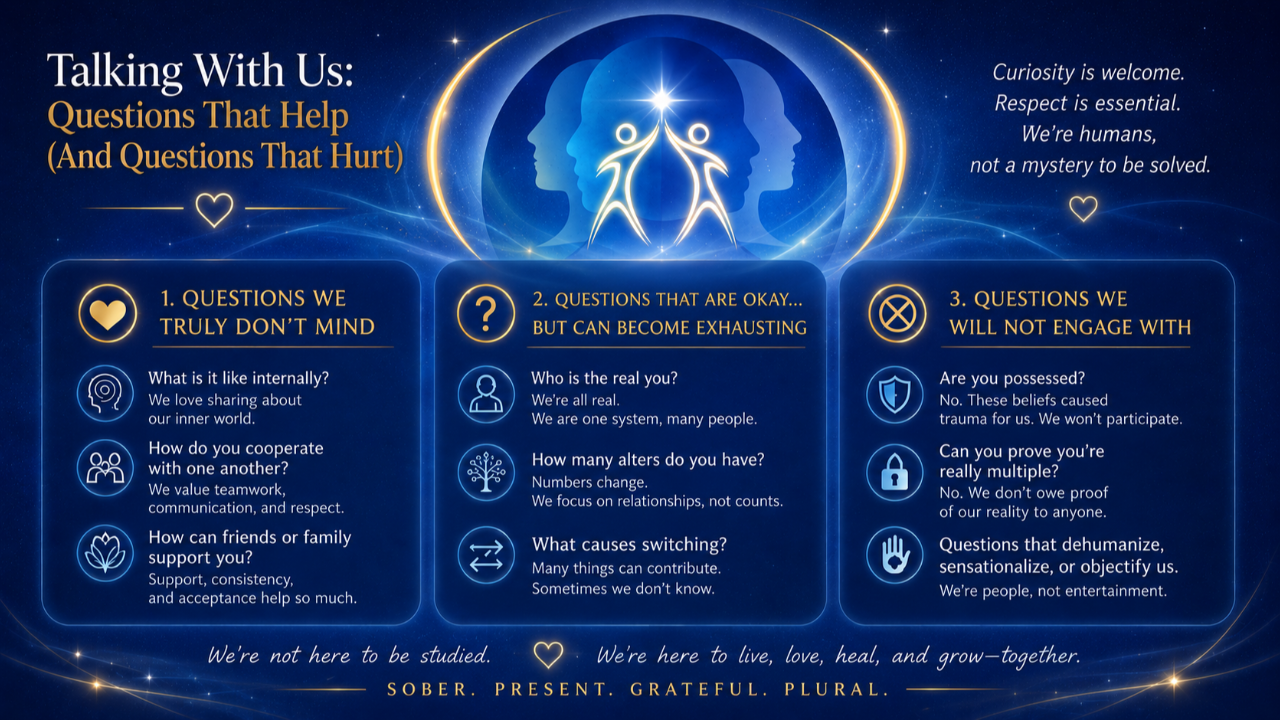
Our thoughts on curiosity and boundaries in a world that wasn’t designed by or for dissociative systems: Part 1 of 3
We knew that going public about living as a dissociative system would mean questions … lots of questions. And that’s okay. Dissociative Identity Disorder is much more common than people realize and yet still widely misunderstood and stigmatized.
Most folks know about DID from movies, television, and internet stereotypes. So, when someone openly says, “oh yeah guess what, we’re a multiple,” curiosity is a natural response.
In many cases, we actually appreciate the questions. We would rather people ask respectfully than silently invent stories in their heads. A lot of confusion and stigma can be resolved simply by asking us.
And visibility matters. We stopped hiding from the world for several reasons, not least of which was that hiding just hurt too damn much. But a big reason is we want people to understand that systems are not automatically dangerous, incompetent, manipulative, or crazy. We are showing, just by being unapologetically us, that dissociative systems are people, too.
Systems like us exist all around you; it’s just that most of them are not public with their diagnosis. We run businesses, have relationships, hold spiritual beliefs, have hobbies, and love our favorite movies, songs, foods, and jokes. In other words, we are a lot like you. Our brain just processes things differently and we have different strengths and weaknesses.
At the same time, being so open does not mean we are abandoning boundaries; if anything, we are being much more thoughtful about boundaries than we used to be
Thus, one of the most important things we have learned over the last ten months is this: authenticity and transparency are not the same thing as total access.
We want to be visible without becoming public property, and we are eager to educate without performing for other people’s curiosity.
So we thought it might be useful to talk about three kinds of questions:
(1) Those we truly don’t mind ... seriously, ask away! We are happy to engage.
(2) The ones that are okay to ask but sometimes are tiring … there’s nothing wrong with asking and we don’t begrudge you. Just know sometimes we’ll be annoyed.
(3) The questions we simply will not engage with anymore ... well-meaning or not, these question are hurtful and we simply don’t engage with them, so please don’t ask.
We'll address the first category today, then the next two over the following days.
Please keep in mind this is not the “Official Guide to Talking to Systems.” We are only speaking for ourselves. Other systems can and will feel differently. But perhaps this helps people relate to us (and maybe to other systems, too) with a little more understanding and humanity.
Today's Category: Questions We Truly Don’t Mind
The questions we generally welcome (and even enjoy) typically come from a place of genuine care, relationship-building, and a desire to understand our lived experience. These questions tend to treat us like a person rather than a puzzle to be solved.
"Who's fronting right now?/Who am I speaking with?"
This one we genuinely don't mind. And we want be clear that this answer is specific to us, because many systems (maybe even most?) find this question uncomfortable or intrusive for completely valid reasons. We're only speaking for ourselves here.
When we decided to go public, we made a collective commitment: if you want to front, you can front, and you agree to be honest about who you are if someone asks. Accountability and belonging go hand in hand for us.
So if you ask who's fronting, we'll tell you. We may not announce a switch in real time … indeed switches can be subtle and we typically don’t narrate them as they happen. But if you notice something shifted and you're curious, just ask.
We do have an exception for safety. If revealing themselves feels physically or emotionally unsafe for the fronting headmate, they might mask or deflect. We consider that to be a healthy boundary rather than dishonesty.
This question, when asked by people who know us, usually comes from a good place, where people are genuinely trying to relate to us as individuals rather than as some undifferentiated "they." We appreciate that and we know it means you're paying attention.
Just don't be surprised if the answer is someone you haven't met yet 😊
“What is it like internally?”
This is a huge topic with more than we can cover, but we usually enjoy discussing it.
Our internal life includes:
- Shifting roles and relationships
- Different emotions and perspectives
- Different tastes and preferences
- Different spiritual paradigms
- Wide range of presentations in terms of age, gender, and other characteristics
- Conversations that involve words, images, and emotional textures
- Varying degrees of co-consciousness depending on who is closer or farther from the “front” at any given moment
Sometimes our internal world feels like a family. Sometimes more like a committee. It’s definitely a vibrant spiritual ecosystem. Some days it’s a chaotic and hilarious group chat and some days deeply peaceful.
We love each other and hurt each other’s feelings. We fight and we make up. We do our best to hash out disagreements and reach consensus on important decisions. In many ways we are just like any group of diverse people living under one roof.
For some of you who are not multiple but have active internal parts, you’ll related to much of that.
“How do you cooperate with one another?”
We actually LOVE this question because it reflects two of our deepest values:
- Collaboration and sharing rather than suppression
- Belonging as a right, and not something that’s earned
We spend a tremendous amount of time (as in, several hours each day):
- Regulating our nervous system
- Improving communication and relationships
- Checking in with one another
- Taking collective accountability while reducing blame and shame
- Setting and respecting internal boundaries
- Doling out and sharing responsibilities
- And simply learning how to function as a team
We have no desire to become anything other than multiple. Our goal is becoming more cooperative, more loving, and more functional together … and hopefully making just a little progress each day.
“How can friends or family support you?”
Questions of this nature mean a lot because they are relational rather than voyeuristic, so we welcome these questions.
Supporting us might look surprisingly ordinary:
- Being kind and patient, as we easily get triggered, dissociated, and distracted
- A willingness to listen without judgment
- Not freaking out when we switch in front of you
- Respecting our preferred names and pronouns
- Not treating us like a spectacle or a curio
- Keeping in mind that different headmates will present and relate to you in a variety fo ways
And, honestly, the biggest thing is simply not asking us to hide again.
“How has sobriety affected your system?”
We are very open about the fact that our system awareness and sobriety emerged together. Our sobriety date and system-awareness date is July 28, 2025.
For decades, alcohol and opioids suppressed our unpleasant emotions and our internal awareness, while increasing chaotic and unproductive dissociation. Sobriety changed everything, giving us space to hear one another, feel one another, and develop internal relationships.
Getting sober did not “cause” our plurality, but it did reveal our plurality … or, at least, it revealed it to those of us who didn’t know we were plural, and allowed us all to be fully aware of one another. Addiction recovery is therefore a central component of our life together and we are all on board.
“Who are the “Littles”?
“Littles” is the term we use to refer to our alters who present as under the age of 7. If a Little is fronting they might try to mask and sound adult with varying degrees of success. Mostly now they do not mask, and you’ll immediately know we are Little because we will transform in front of your eyes into a small child.
We are careful about switching and turning Little; we only do it if we feel physically and emotionally safe. Littles do not like to front in public unless accompanied by an adult human whom they trust implicitly. Littles do not drive a car. Littles do not interact with strangers.
Littles like to do Little things. They watch kid movies, read picture books, eat cookies, and color. They have a rainbow unicorn plushy.
If you encounter a Little, please remember that they are not literally a small child; in fact they tend to be among the oldest alters in the system … the ones we know existed very early in our physical development. They also are trauma-holders, who keep careful guard over our worst and earliest memories in order to protect the system as a whole. They are incredibly brave and very wise.
And yet … they do feel and behave like small children. They are sensitive and easily hurt. They feel great joy at simple things. They like to laugh and be silly. They get confused and have a hard time with big words.
The Littles are also shockingly powerful and capable.
If you meet one, consider it a privilege and a sign of just how highly our system thinks of you.
“What are the positive aspects of being multiple?”
We appreciate this question because most public conversations about DID focus on suffering, trauma, daily difficulties, and maladaptive behavior.
And, sure, there are painful and dysregulating aspects. Some tasks that most people find simple are herculean for us. After all, there’s a reason it’s called a “disorder” and we don’t deny it can be difficult to function in daily life.
And yet … there are also such beautiful gifts:
- Creativity and pattern recognition
- Emotional sensitivity and nuance
- Tremendous resilience and adaptability
- Deep internal companionship and rich imagination
- Openness to multiple perspectives
- Strong intuition
- Capacity for thinking in symbols and energies
- Profound empathy and care for those who suffer
We do not romanticize trauma and we do not justify the things that happened which made us this way. But we also are grateful for what we are and we can forgive the people in our past. And we longer see ourselves as broken or abnormal. We just … are.
And we genuinely love being a system.
In our next post ...
Our next post will answer a number of questions we hear on a regular basis, and which we honestly understand why people are asking. So we don't begrudge those questions, but given our history they can be a little tiring.
