
Asking a Multiple Part 2 of 3: Questions That Are Okay ... But Can Be Tiring
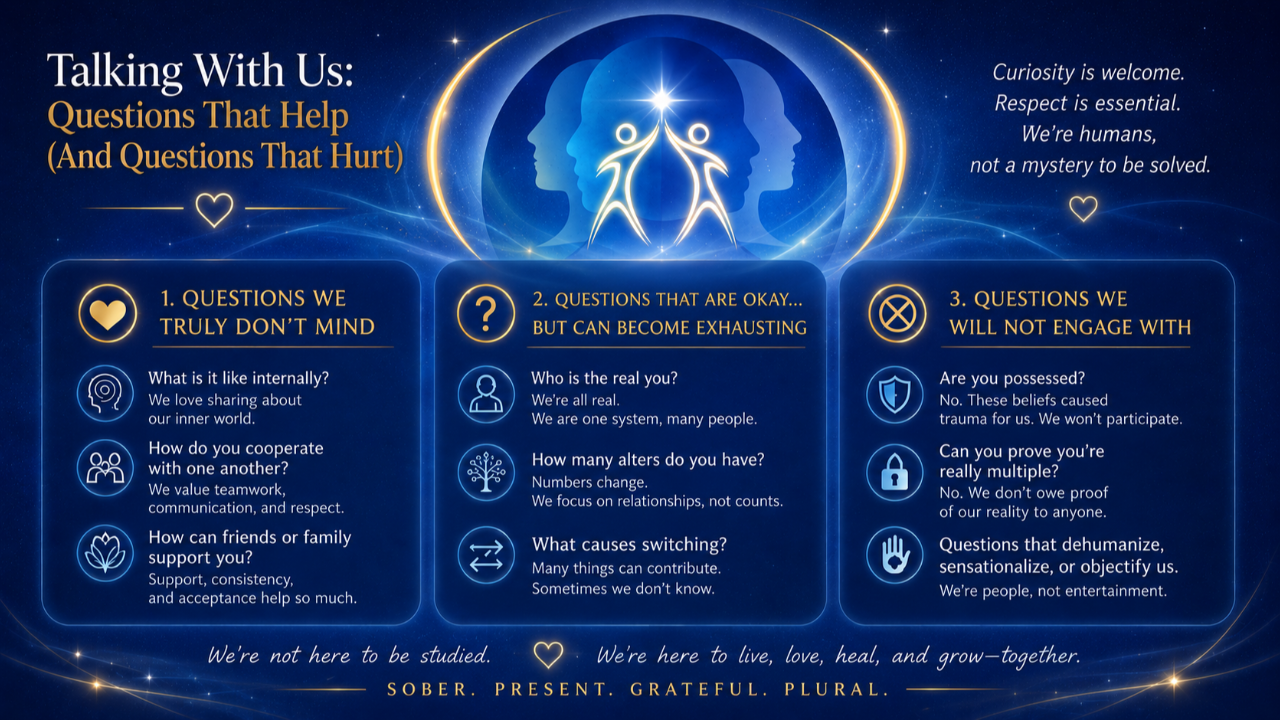
Our thoughts on curiosity and boundaries in a world that wasn’t designed by or for dissociative systems: Part 2 of 3
This is the second in our three-part series where we answer common questions we hear. Our previous post was about questions we genuinely don't mind people asking, and we don't mind answering. Our next post will be about boundaries we set and the questions that we don't engage with.
Today's Category: Questions That Are Okay … But Can Be Tiring
These questions are not inherently offensive, and can come from a genuine desire to relate. We also absolutely understand why people ask, especially given society’s broader stigma and misunderstandings about DID.
But hearing these questions repeatedly can be emotionally tiring for some of us. They tend do be based in assumptions and frameworks that don’t really apply. So, it's totally okay to ask these questions; but if we seem annoyed, please know it’s about our history and it's nothing personal against you.
“Who is the real Ian?”
All of us. We’re all the real Ian.
People ask this because western culture assumes there must be one “real” or “core” or “authentic” identity state. But that is simply not how we experience ourselves.
We are all equally real. We are all indispensable parts of the whole person you see. No single headmate claims exclusive ownership over our body, our history, our relationships, or our existence.
Indeed, the vast majority of us don’t even identify with the name Ian, meaning most of the time you are not actually speaking to an “Ian” …
“Which one of you is the original Ian?”
So, we totally get the question intellectually, especially with how DID is portrayed in pop culture and even with how DID was once treated by the medical community.
But we don’t experience ourselves as having grown out of, or split from, one original identity state. We developed in parallel during overlapping time frames. We are a family that evolved over time for many reasons and to adapt to many situations.
Trying to locate the “original Ian” is an exercise in futility. We don’t know if there was an original Ian. (Indeed, the modern clinical theory of dissociation suggests there probably was not.) Even if there was, we don’t know who it would have been. There are at least ten of us who can trace memories back to early childhood.
Regardless, it just doesn’t matter. What matters is caring for everyone who’s part of the system today.
“How many alters do you have?”
We used to try very hard to answer this with actual numbers, including how many are male and female, how many are young and old, even how many present as non-human.
Now, well, not so much.
Counting and categorizing alters used to feel important because fully awakening was disorienting and disconcerting. We were reaching for some sort of stability and certainty.
Over time, we realized that focusing on numbers and categories had created an unintentionally hierarchy. Without meaning to, we had cultivated a sense of who’s more or less important, who’s more or less useful, and who’s more or less part of the “cool kids” clique.
That was damaging to internal relationships and it meant a number of headmates felt hurt, and several even stayed hidden because they felt left out.
These days, there’s no more counting or categorizing. We focus on our internal relationships. We are creating a space where everyone can feel love and belonging as a right, and not as something they must earn.
So the answer is: we are an evolving internal family of some few dozen headmates, maybe more, all of whom are precious and wanted and loved.
“What causes switching?”
Everything and nothing.
Sometimes it’s a known positive or negative trigger. Sometimes it’s an emotional need or energy levels or stress levels. Often it’s about who wants to front and, so long as it’s safe to do so, we allow it. It can also be a collective determination that one or another alter is better suited for a situation. Sometimes it’s literally an accident … someone “slips” out front unintentionally when there’s a gap.
And, well … sometimes we just don't know why we switched.
Understand that our switching is typically not obvious. For most systems, and certainly for us, real-life switching can be quite subtle.
Pop culture has taught us that switching means blackouts, obvious changes in voice and mannerisms, or dramatic behavioral changes.
Real systems are generally more nuanced. The better you get to know us, the more you’ll notice the switches. Our wife and therapist and a few close friends are pretty good noticing a switch and even guessing who is fronting. But that's after lots of interaction and relating to us.
“Can I talk to [name of specific alter]?”
This depends heavily on context and the nature of your relationship with us.
Some of us are social butterflies who front quite often. Others are private and very rarely front. Some of us enjoy attention and human interaction while others really don't.
Importantly: some of us can be very well suited to front in some contexts and poorly suited to front in other contexts, as we have different strengths and weaknesses.
So, in general, we are okay with respectful requests, especially if you have an established relationship with the alter you’d like to speak to. But keep in mind that a plural system is not a vending machine where you request a specific person on demand.
In our next post ...
Our next post will gear more toward boundary setting. Well-meaning people might ask questions without understanding how those questions feel harmful from our perspective. Our next post will answer those questions. And from then on, we simply won't engage with those questions any longer.
